Spotify's New Video Controls Let Families Turn Off Music Videos and Canvas
Spotify's latest controls let Family plan managers rein in music videos and Canvas, a small change that could make the app feel much calmer at home.
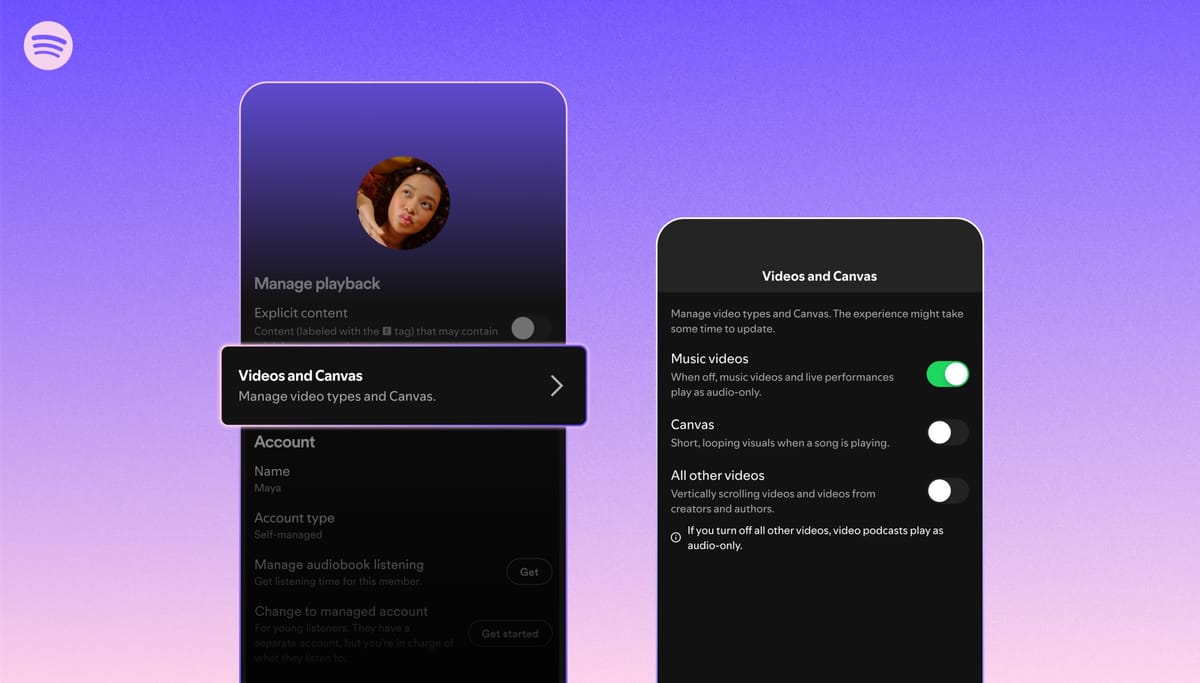
Spotify has added a surprisingly practical family feature. The company now lets Premium Family managers switch video content on or off for any member of the plan, while also rolling out broader video settings for individual users across its service. It is a small product change on paper, but it speaks to a bigger tension in modern streaming apps: not everyone wants every screen to become a video feed.
For families especially, this update lands in a useful place between convenience and control. Spotify is not abandoning video. It is admitting that people want a cleaner way to decide when video belongs in the experience at all.
What changed on Spotify
In its April 9 announcement, Spotify said Family Plan managers can now switch video content on or off for any plan member through subscription settings. Until now, Spotify says similar controls already existed for managed accounts aimed at younger listeners. The new change extends the idea to any Family plan member account.
Spotify also says it is introducing broader settings so Premium, Basic, and free users can control how video appears in the app. That includes music videos, other videos, and Canvas visuals, the short looping clips that appear while songs play. The company's support documentation says those settings apply across mobile, desktop, web player, and TV.
Why this matters more than it sounds
Music and podcast apps have been drifting toward a more visual, feed-like experience for years. Sometimes that is useful. Sometimes it just makes a service feel louder. Spotify's new controls are notable because they acknowledge that audio-first listening is still a valid preference, especially in homes where different people use the same family plan in very different ways.
That makes this feel like more than a checkbox feature. For parents, it offers another lever for shaping a calmer experience. For everyone else, it is a reminder that the future of media apps is not only about adding more formats. It is also about giving people a better say in how much stimulation they want.
What you can actually turn off
Spotify's support page breaks the controls into three buckets: music videos, other videos, and Canvas. Other videos can include things like creator videos, video podcasts, fitness videos, and audiobook trailers. For family managers, the key point is that these settings can now be adjusted for other members of the plan, not just for managed child-focused accounts.
There is one important caveat. Spotify says video ads cannot be turned off on the free ad-supported plan, and Canvas visuals may still appear with some audio ads. So this is not a total no-video mode for every account type. It is a stronger preference system, not an absolute kill switch across the entire service.
How families can use it well
The obvious use case is younger listeners, but the broader opportunity is household customization. One person might want the full visual layer for music and podcasts. Another may want Spotify to behave more like a lean-back audio service. A family manager can now make those differences explicit instead of treating the whole household as if it uses the app the same way.
That is especially helpful in a moment when apps keep absorbing more formats, more feeds, and more algorithmic distractions. Spotify's update is not a revolution, but it is a reasonable quality-of-life feature for people who want more control over what daily media use actually feels like.
The bigger read on this move
Tech companies usually talk about engagement when they add more surfaces, more motion, and more media types. Spotify is making a quieter argument here. More control can also be a product advantage. If users feel like the app respects the difference between listening, watching, and scrolling, that can be just as valuable as pushing them deeper into video.
For a family-oriented feature, that is the right tone. Spotify is still clearly building toward a richer media platform. But this update suggests it also knows that households need control tools if that broader platform is going to feel livable.